

18th International Congress on Quantum Chemistry
May 31st to June 5th, 2026
Berkeley, California, USA
Satellite Meetings
In addition to ICQC 2026, a three satellite meetings will be taking place that may be of interest. Registration for satellite meetings will be handled separately from ICQC 2026 registration.
| Quantum Advantage for Computational Chemistry (Friday, May 29th)
The Quantum Advantage for Computational Chemistry satellite meeting will precede ICQC2026, taking place on Friday May 29, at the Simons Institute for the Theory of Computing, on the Berkeley campus. The meeting will focus on quantum algorithms with promise of significant quantum advantage in chemistry, considering electronic structure and dynamics, as well as integration of quantum and classical high performance to solve complex chemical problems beyond the reach of classical computers.
| Registration
Registration for the Quantum Advantage for Computational Chemistry is open! Registration is free. Both in person and live stream (remote) registration are possible.
| Confirmed Speakers
Andrew Baczewski (Sandia)
Garnet Chan (Caltech)
Matthias de Groote (Boehringer Ingelheim SComm)
William Huggins (Google)
Ivan Kassal (Univ. Sydney)
William Kirby (IBM)
Karol Kowalski (PNNL)
Oskar Leimkuhler (Univ. Copenhagen)
Peter Love (Tufts)
Nick Rubin (Google)
Torin Stetin (Xanadu)
| Schedule
The Quantum Advantage satellite meeting will have 2-3 sessions of talks and a panel discussion.
| Speaker | Title | ||
|---|---|---|---|
| Friday, May 29th | Time | Event | Title |
| 8:30 AM | 9:00 AM | Check-in and breakfast/coffee | |
| 09:00:00 | 9.35 AM | Ivan Kassal | End-to-End Simulation of Chemical Dynamics on a Quantum Computer |
| 9:35 AM | 10:10 AM | Torin Stetina | Quantum Simulations of Spectroscopy: Algorithms and Applications |
| 10:10 AM | 10:30 AM | Coffee | |
| 10:30 AM | 11:05 AM | Nick Rubin | Leveraging Low-Energy Assumptions for Quantum Speedups |
| 11:05 AM | 11.40 AM | Karol Kowalski | Dimensionality Reduction Methods for Quantum Simulation of Chemical Processes |
| 11:40:00 | 12.15 PM | Will Kirby | Obervation of Improved Accuracy over Classical Sparse Ground State Solvers using a Quantum Computer |
| 12:15:00 | 2.00 PM | Lunch (not provided) | |
| 2:00 PM | 2:35 PM | Oskar Leimkuhler | Exponential Quantum Speedups for Near-Term Molecular Electronic Structure Methods |
| 2:35 PM | 3:10 PM | Matthias Degroote | Coupled Quantum-Classical Dynamics in the Liouvillian Framework |
| 3:10 PM | 3:30 PM | Coffee | |
| 3:30 PM | 4.05 PM | Garnet Chan | Quantum Advantage in the Age of Classical Simulation |
| 4:05 PM | 5.00 PM | Panel Discussion: led by Andrew Baczewski, Bill Huggins, Peter Love | Prospects for Quantum Advantage in Chemistry - near term and long term |
| 5:00 PM | 6:00 PM | Reception | |
| 6:00 PM | End of workshop | Departure |
| Organizers
Birgitta Whaley, Univ. of California, Berkeley, USA
| The Current State of the Art in Machine Learning for the Chemical Sciences
(June 5th - June 6th)
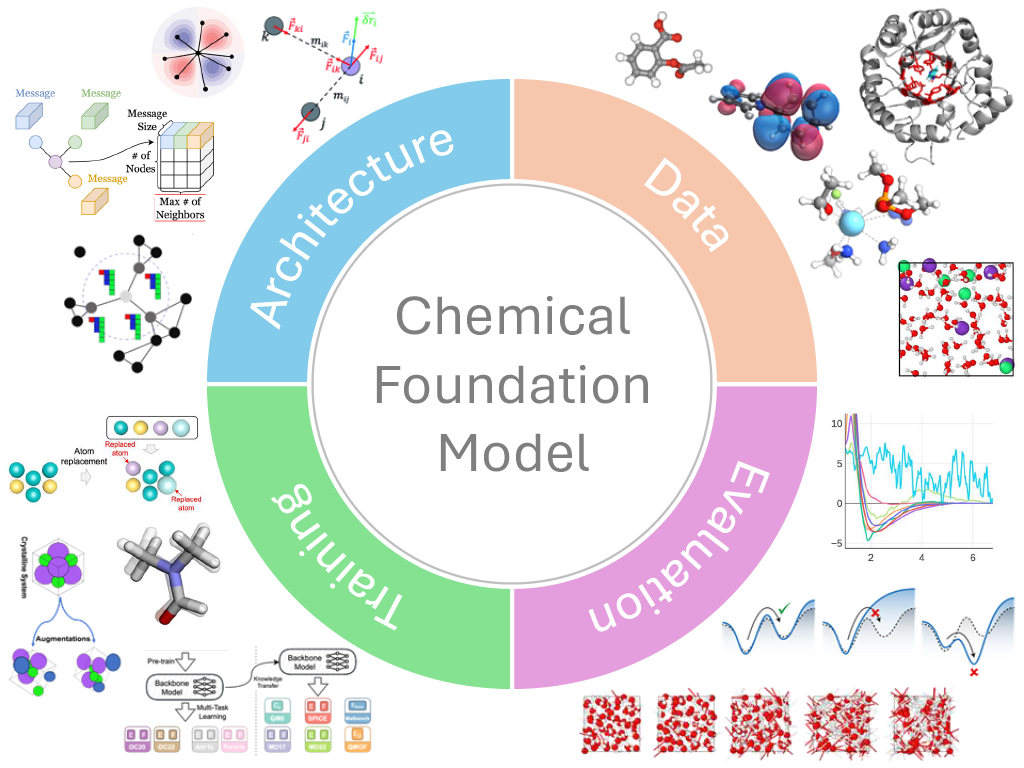
The Machine Learning for the Chemical Sciences symposium begins on Friday morning as the last session of the ICQC conference, and continues through Friday afternoon and all day Saturday. We have an excellent lineup of speakers that are leaders in ML/AI methodology that are advancing the field to learn Schrodinger’s equation for energies and forces and to advance Newton’s equation of motion on energy surfaces, and to describe phases, interfaces, and functional properties of chemistry and materials. A small registration fee of $75 for graduate students and postdocs and $120 for all senior scientists will support coffee breaks and lunch on Saturday.
| Registration
Registration is open. Registration includes coffee breaks on both meeting days, as well as a lunch on June 6th.
Student and Postdoc
Until May 31st, 2026
$75 USD
General
Until May 31st, 2026
$120 USD
| Abstract Submission
In addition to our confirmed speakers, we will be accepting 8, 15 minute, contributed talks. If you are interested in submitting an abstract, please see our abstract submission portal. Note, you must register for The Current State of the Art in Machine Learning for the Chemical Sciences in order to submit an abstract.
| Confirmed Speakers
Victor Batista (Yale)
Sam Blau (LBL)
Rose K. Cersonsky (Wisconsin)
Garnet Chan (Caltech)
Gabor Csanyi (Cambridge/Mainz)
Robert Distasio (Cornell)
Fernanda Duarte (Oxford)
Weinan E (Peking)
Olexandr Isayev (CMU)
Risi Kondor (Chicago)
Boris Kozinsky (Harvard)
Heather Kulik (MIT)
Tom Markland (Stanford)
Jeff Neaton (Berkeley)
Shyue Ping Ong (Singapore)
Jutta Rogal (Flatiron)
Alexandre Tkatchenko (Luxembourg)
Brandon Wood (META)
| Schedule
Below is the official schedule for the meeting.
| Poster Session Information
The poser session will take place on Friday, June 5th. Posters can be put up at Tan Hall starting after noon on Friday. Poster discussions will be Friday 6:00p - 7:30p and during all coffee breaks on Saturday.
There will be a flash poster session; presenters should upload one slide to the Google Drive link HERE. Each poster presenter will give a two-minute oral summary.
| June 5 (Fri) | Speaker | Title | June 6 (Sat) | Speaker | Title |
|---|---|---|---|---|---|
| 8:30-9:00 | Morning coffee | ||||
| Chair: Teresa Head-Gordon | Chair: Victor Batista | ||||
| 8:30-9:05 | Weinan E | Large atomistic models: from DPA-1 to DPA-4 | 9:00-9:30 | Gabor Csanyi | MACE models with explicit electrostatics |
| 9.05-9:35 | Alexandre Tkatchenko | AI-Enabled (Bio)Molecular Simulations Beyond AlphaFold and Empirical Potentials | 9:30-10:00 | Olexandr Isayev | AIMNet2: Foundation neural network potentials for molecules, reactions, and CADD-related tasks |
| 9:35-10:05 | Brandon Wood | Scaling quantum accuracy from DFT to MLIPs: Progress, Pitfalls, and Prospects | 10:00-10:15 | Allen LaCour | An Edge Cluster Expansion for Machine Learning Interaction Potentials |
| 10:05-10:30 | coffee | 10:15-10:30 | Peter Eastman | Accuracy and Efficiency Benchmarks of Pretrained Machine Learning Potentials for Molecular Simulations | |
| Chair: Bingqing Cheng | 10:30-11:00 | coffee | |||
| 10:30-11:00 | Heather Kulik | What can more data do for accelerated discovery in transition metal chemistry? | Chair: Aditi Krishnapriyan | ||
| 11:00-11:30 | Fernanda Duarte | Reaction modelling: from mechanistic insights to data-driven exploration | 11:00-11:30 | Risi Kondor | The structure of higher order Clebsch--Gordan products |
| 11:30-12:00 | Paola Gori-Giorgi | Accurate and Scalable Exchange-Correlation with Deep Learning | 11:30-12:00 | Jutta Rogal | Scalable Boltzmann Generators for Free Energy Estimates |
| Lunch (provided) | |||||
| Chair: David Limmer | Chair: Tom Markland | ||||
| 1:30-2:00 | Garnet Chan | 1:30-2:00 | Boris Kozinsky | ||
| 2:00-2:30 | Tom Markland | Using AI to push the limits of 1D NMR for structure elucidation | 2:00-2:30 | Jeff Neaton | Accelerating Crystal Structure Prediction and Spectroscopy with Machine Learning |
| 2:30-2:45 | Sijia Dong | Environment-Aware Machine Learning Approaches for the Design of Macromolecular Photoredox Catalysts | 2:30-2:45 | Benjamin X. Shi | Efficient machine-learning framework for coupled cluster interatomic potentials in the condensed phase |
| 2:45-3:00 | Martin Stoehr | Differentiable Quantum Chemistry: Hybrid Machine Learning Models and More | 2:45-3:00 | Dongjin Kim, Daniel S. King, Yoonjae Park | Getting More from LES: Dipoles & Quadrupoles in Long-Range Machine-Learned Potentials |
| 3:00-3:30 | coffee | 3:00-3:30 | coffee | ||
| chair: Rose K. Cersonsky | chair: Weiluo Ren | ||||
| 3:30-4:00 | Shyue Ping Ong | Efficient Approaches to Modelling Long-Range Interactions in Machine Learning Interatomic Potentials | 3:30-3:45 | Ruichen Li | Agentic Discovery of Exchange--Correlation Density Functionals |
| 4:00-4.30 | Robert Distasio | 3:45-4:00 | Piero Altoe | Accelerating the Discovery Loop: Production-Ready Tools for GPU-Powered Materials Science | |
| 4:30-5:00 | Victor Batista | Generative Chemistry with Autoregressive Models: From Molecular Design to Retrosynthesis | 4:00-4.30 | Sam Blau | OMol25-trained MLIPs in practice and Open Polymers 2026 |
| 4:30-5:00 | Rose K. Cersonsky | Leveraging how models see data to understand model performance and derive chemical hypotheses |
| Venue
The Friday morning session will be located at the Pauley ballroom (Google Maps), and the rest of the sessions (Friday afternoon and Saturday) will be in 120 Latimer Hall, UC Berkeley campus (Google Maps). The two locations are approximately 10 minutes away by walking.
| Organizers and Contact Information
| Organizing Committee
Teresa Head-Gordon, University of California, Berkeley, USA
Bingqing Cheng, University of California, Berkeley, USA
For questions related to the Current State of the Art in Machine Learning for the Chemical Sciences, please email mlchem2026icqc@gmail.com.
| Advances in Electronic Structure Theory and Dynamics (June 6th - June 10th)
The Advances in Electronic Structure Theory and Dynamics satellite meeting will take place at the University of California, Merced, from June 6–10, 2026. This focused meeting will bring together leading researchers for in-depth discussion of emerging directions in electronic structure theory and chemical dynamics, including relativistic theory, nonadiabatic and electron dynamics, excited states, strong correlation, and periodic and extended systems. The program will feature invited lectures along with a poster session and selected contributed talks to broaden participation and discussion. Shuttle transportation will be arranged from Berkeley to Merced following ICQC and back to the Bay Area at the conclusion of the meeting to facilitate travel to major airports. On-campus and nearby lodging options will be available for participants, and a day trip to Yosemite National Park will be organized during the meeting.
For additional information regarding the meeting, please see the main page from UC Merced HERE.
| Registration
Registration is open. Please see registration pricing below
Student
$250 USD
General
$350 USD
| Abstract Submission
In addition to the confirmed invited speakers, the program will include a poster session and selected contributed talks. We especially invite early career colleagues, postdocs, and students to submit abstracts.
| Confirmed Speakers
Hugh Burton (Univ. College London)
Marco Caricato (Univ. Kansas)
Martin Head-Gordon (Berkeley)
Matthew Hermes (Chicago)
Paul Johnson (Univ. Laval)
Xiaosong Li (Washington)
Devin Matthews (Southern Methodist University)
Andrés Montoya-Castillo (Boulder)
Péter Nagy (Budapest)
Eric Neuscamman (Berkeley)
Bo Peng (PNNL)
Piotr Piecuch (Michigan State)
Jiří Pittner (CAS)
Krishnan Raghavachari (Indiana)
Elvira Sayfutyarova (Penn State)
Berny Schlegel (Wayne State)
Gustavo Scuseria (Rice)
Sandeep Sharma (Caltech)
Vidushi Sharma (Princeton)
Jiace Sun (Caltech)
Lee Thompson (Louisville)
Sergey Varganov (Reno)
Xiao Wang (Santa Cruz)
Tianyu Zhu (Yale)
Paul Zimmerman (Michigan)
| Organizers and Contact Information
Hrant Hratchian, University of California, Merced, USA
Christine Isborn, University of California, Merced, USA
Herik Larsson, University of California, Merced, USA
Aurora Pribram-Jones, University of California, Merced, USA
Liang Shi, University of California, Merced, USA
David Strubbe, University of California, Merced, USA
Gustavo Scuseria, Rice University, Houston, Texas, USA
James Shee, Rice University, Houston, Texas, USA
For questions related to the Advances in Electronic Structure Theory and Dynamics meeting, please email hhratchian@ucmerced.edu.